Recipe for a sharper ML intuition
Reading time: 2 minutes
Ingredients: a confusion matrix, four formulas, and a willingness to experiment
Difficulty: 🟡⚪⚪⚪⚪
Complexity drill-down:
- 🟡 Read the four memory hooks: each metric is reduced to one question
- ⚪ Edit the confusion matrix values and watch the scores update in real time
- ⚪ Load a preset scenario (cancer screening, spam filter, fraud detection) to see trade-offs in context
- ⚪ Read the natural-language interpretation that explains what the numbers actually mean
- ⚪ Reward: the confidence to pick the right metric for the problem at hand
Perfect song for the recipe
Accuracy, precision, recall, and F1 score are the first metrics most people learn in machine learning, and the first they forget. The formulas are simple enough to recite, but the intuition behind when each one matters tends to blur together once you move past a toy example. This post is part of my broader Data Science Insights collection on practical data preparation, modelling, and evaluation.
The core issue is that a single number can make a model look great or terrible depending on which mistake you care about. A cancer screening model that catches 99% of cases might look like a success on recall alone, until you realise it is flagging healthy patients every other day. A spam filter with perfect precision might miss half the junk mail, but at least it never buries an important email.
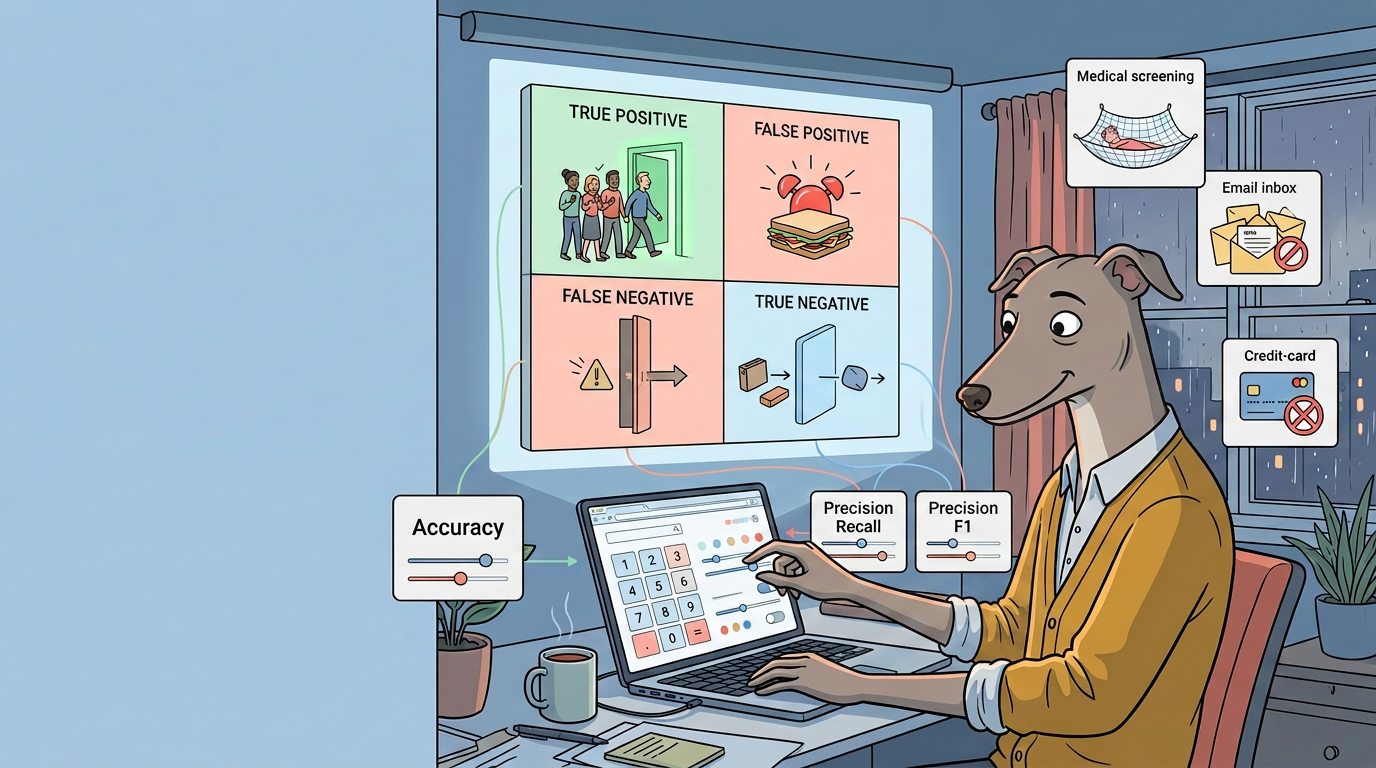
I wanted a way to make those trade-offs tangible, so I built a small tool that lets you edit a confusion matrix and see the metrics shift in real time.
The App
Start by reading the four memory hooks, each metric is reduced to a single question you can actually remember. Then open the interactive calculator: change any value in the confusion matrix and watch accuracy, precision, recall, and F1 update instantly. Try loading one of the preset scenarios – balanced model, cancer screening, spam filter – to see how the same numbers tell different stories depending on context.
If the embed does not load well on your device, open the full-page version here: https://viscioletti.com/apps/machine-learning/signal-vs-noise
How The Metrics Work
All four metrics start from the same building blocks: the four cells of a confusion matrix. Every prediction a model makes falls into one of four buckets:
- True Positive (TP): the model said yes, and it was right.
- False Positive (FP): the model said yes, but it was wrong – a false alarm.
- False Negative (FN): the model said no, but it was wrong – a miss.
- True Negative (TN): the model said no, and it was right.
From those four numbers, the metrics diverge:
\[ \text{Accuracy} = \frac{TP + TN}{TP + FP + FN + TN} \]
Accuracy answers: how often is the model right overall? It treats every correct prediction equally, which makes it misleading when one class is much rarer than the other. A model that predicts “no disease” for every patient can be 99% accurate in a population where only 1% are sick – and still be useless.
\[ \text{Precision} = \frac{TP}{TP + FP} \]
Precision answers: when the model says yes, can I trust it? High precision means few false alarms. This matters when the cost of a false positive is high – flagging a legitimate email as spam, or recommending an unnecessary medical test.
\[ \text{Recall} = \frac{TP}{TP + FN} \]
Recall answers: of all the real positives, how many did the model find? High recall means few misses. This matters when the cost of a false negative is high – failing to detect a disease, or missing a fraudulent transaction.
\[ \text{F1} = \frac{2 \times \text{Precision} \times \text{Recall}}{\text{Precision} + \text{Recall}} \]
F1 score answers: is the model both trustworthy and complete? It is the harmonic mean of precision and recall, so a weak one pulls the whole score down. Use it when you need a single number for an imbalanced problem and both types of error matter.
Which Metric Matters Most?
The cost of a mistake decides the priority. The app includes three built-in examples that illustrate this clearly:
- Disease screening favours recall. A missed diagnosis can delay care, so you cast a wide net and accept more false alarms to catch every real case.
- Spam filtering favours precision. A false alarm hides an important email, so you only flag messages you are very sure about.
- Fraud detection needs all three. Most transactions are legitimate, so accuracy alone is misleading. Precision tells you how many flagged transactions are actually fraudulent, recall tells you how much fraud you are catching, and F1 balances the two.
The interactive calculator makes these trade-offs visible. Load the cancer screening preset and note the high recall but low precision. Then switch to the spam filter preset and watch the numbers flip. The same underlying math, but a completely different priority.
A Note On Scope
The app focuses on binary classification – positive versus negative. Real-world problems sometimes involve multiple classes, probability thresholds, or costs that are not symmetric. The metrics here are still the foundation, but the picture gets richer once you move beyond a 2x2 matrix.
The natural-language interpretation in the app is a guide, not a verdict. It flags when precision and recall are noticeably imbalanced, but it cannot tell you which trade-off is right for your problem. That depends on what you are optimising for, and only you know that. When the problem is evaluating an AI system rather than a classifier, the same principle applies: define the behaviour you care about before trusting a score. I wrote about that in BYOB: Bring Your Own Benchmark.
Bookmark It
The app is a single self-contained HTML file. There is no backend, no account, and no tracking; your numbers never leave your browser. Press R anytime to reset the matrix to defaults.
- Use it on the site: https://viscioletti.com/apps/machine-learning/signal-vs-noise – bookmark that URL for a clean, full-page version.
Star the Repo
Signal vs Noise is part of a growing collection of self-contained, single-page web apps for learning and productivity. If you found it useful, consider starring the repo – it helps others discover the collection.